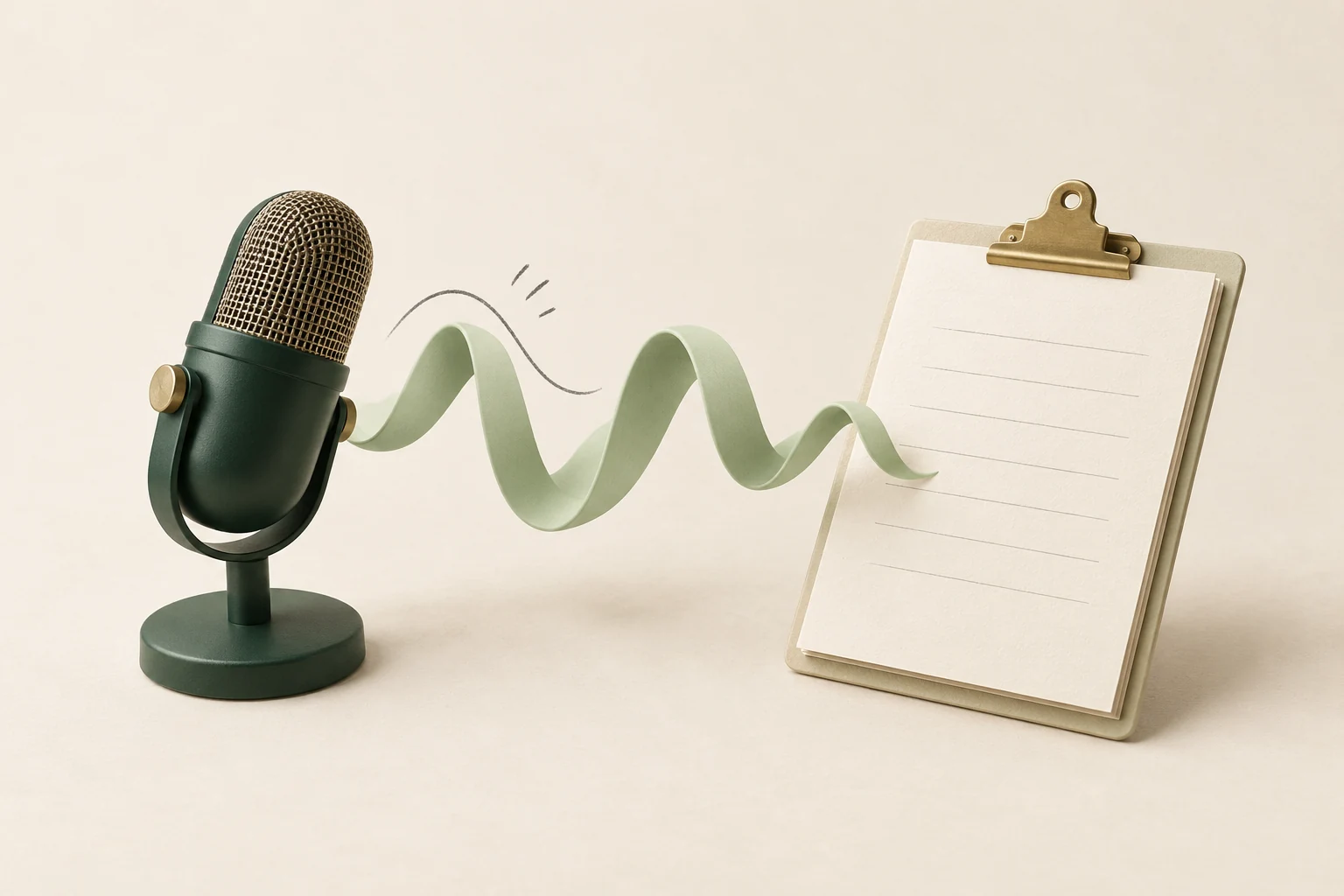
Speech-to-text solves one part of an audio workflow. A reporting product also needs to decide what to capture, how to organize it and how someone can review the result before using it.
In this article
Keep the stages visible
Audio capture, transcription and report preparation have different responsibilities. Capture preserves the input. Transcription represents the speech. Report preparation organizes the relevant information into the structure the workflow expects.
Keeping these stages explicit helps the application show progress and helps an engineer identify which stage needs attention. A problem in transcription should not be hidden by a polished report.
Preserve meaning while changing form
Spoken language is not usually organized like a finished document. It can contain pauses, corrections and repeated phrases. A reporting step may need to reorganize it, but the transformation should stay grounded in the recorded information.
Specialist workflows also need defined fields and terminology. These should be part of the output specification so the system is working toward a known structure rather than improvising one each time.
Build a place to review the result
A review interface is part of the product, not an optional addition after the model pipeline. A reviewer needs to understand what was prepared and have a straightforward way to correct it.
Where the workflow permits it, keeping the original recording and intermediate transcript available can help explain how the report was produced. Access and retention requirements should be decided for the particular organization.
- Show processing and failure states clearly.
- Keep the report structure predictable.
- Allow corrections before the next workflow step.
- Define who can access source audio and prepared documents.
Treat processing as a job
Long recordings may take time to process. Representing the work as a job gives the user a status to return to and gives the backend a place to record completion or failure.
The processing steps can then be retried or investigated without asking the user to repeat the entire interaction. The precise design depends on the length of the input and the application’s requirements.
Connect the pipeline to the working day
The useful output is the document people can actually review and use. That means the audio pipeline has to fit with the existing reporting workflow, including how a document is stored, retrieved and passed onward.
GrossingAI is one of the projects in Hassan Revel’s portfolio that brings audio processing and structured reporting together. It illustrates why a voice feature needs an application workflow around the transcription step.
Explore the work behind the ideas.
Voice & multimodal AI
Written by Hassan Revel
AI solutions for healthcare, business workflows and digital products.